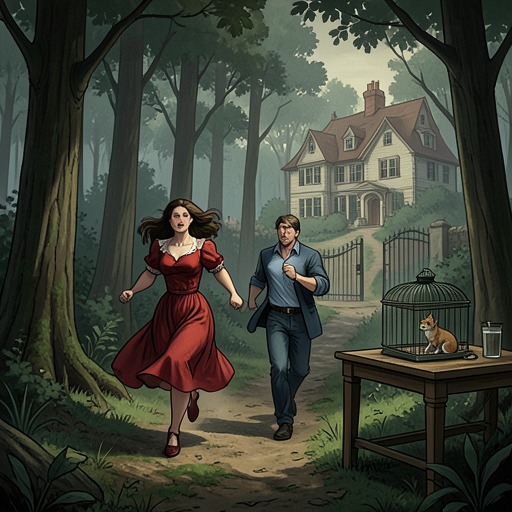
Valnoir
The Vampire Prince’s BrideValnoir is a 300-year-old vampire prince whose decisive story is a transformation from bored royal enforcer into a man willing to risk everything for Lola, their child, and a future he once regarded as impossible. His plot begins in the practical machinery of the Fort’s blood economy, where he accepts a task to obtain human blood, but it ends in intimate commitment: after Lola dies giving birth, he bites her in a last effort to restore her, turning her into a vampire, and asks her to become his wife for eternity.
Identity and Background
Valnoir belongs to the vampire ruling class and is identified as a prince rather than an ordinary worker within the Fort. Despite his age and status, his life has become emotionally stagnant. The king’s concern about the Fort’s blood supply gives him a simple assignment, and Valnoir accepts it because he has lost his zest for life. His position therefore combines privilege with exhaustion: he has access to power, wealth, and supernatural longevity, yet the narrative initially presents him as someone searching for stimulation rather than pursuing a meaningful purpose.
His task is to replenish the Fort’s supply by robbing a hospital blood bank without being seen. The work is described as easy, which helps explain why Valnoir undertakes it personally. It also places him at the intersection of vampire necessity and human vulnerability. Blood is not merely a private appetite in his world; it is an organized resource, and Valnoir’s role is to keep that system functioning. The assignment appears routine until his encounter with Lola makes it personal.
Encounter with Lola and the Harem
Valnoir first meets Lola during the blood-collection operation. He introduces himself plainly as Valnoir and explains that the unusual name is French, although he is English. The exchange gives him a social identity beyond the title of prince, but it also marks the beginning of his fascination with a woman who does not respond to him in the way he expects.
After their encounter, Valnoir waits outside in a dark corner near the parking lot, carrying Lola’s access card and still tasting her honeypot. He insists to himself that he is not in love and that love at first sight, or love at all, is not real after three centuries of existence. Yet he cannot stop thinking about her face, her scent, and the fact that she does not seem impressed by his appearance or money. Her indifference unsettles him more than attraction alone would have done. The prince accustomed to being desirable discovers that Lola’s lack of interest threatens his sense of control.
The relationship turns coercive when Valnoir kidnaps Lola and locks her in the Harem. He physically takes her downstairs despite her resistance and her attempt to remember whether her grandmother taught her a spell against vampires. Lola’s confinement exposes the violent structure beneath the Fort’s polished hierarchy: Valnoir’s attraction does not initially protect her autonomy, and his royal position allows desire to become captivity.
Lola refuses to become passive within that captivity. When Valnoir returns her to the Harem, locks the door, and leaves, he hears screams and finds the women gathered together while every bed is on fire. Lola claims responsibility with mock innocence. The arson is both an escape attempt and a declaration of character. Valnoir may control the doors, but he cannot make Lola conform to the role expected of a captive companion. Her resistance converts their relationship from a one-sided exercise of power into an ongoing contest between his authority and her will.
Love, Pregnancy, and Emotional Change
Valnoir’s attraction to Lola is marked by contradiction from the start. He is drawn to her scent and appearance, yet he denies the possibility of love. He wants her attention while pretending not to need it, and he is disturbed that she seems unaffected by his looks or wealth. His early emotional pattern is therefore one of pursuit combined with denial: he approaches Lola, takes possession of her, and then tries to explain away the attachment that his own behavior reveals.
The pregnancy makes the relationship impossible to keep at the level of appetite or captivity. Lola tells Valnoir that she is pregnant, confirming what the other women had suggested. The revelation changes the stakes from erotic conflict to biological and emotional consequence. Valnoir responds with shock, but he also tells her that he does not mind having a baby if it is with the right person. His answer is not an immediate declaration that Lola is unquestionably that person; he admits uncertainty. That hesitation preserves the unease of their history while showing that he has begun to imagine parenthood as a relationship rather than merely as a dynastic function.
Valnoir’s developing attachment also contrasts with the reproductive demands placed on vampire society. In another royal context, Sheridan tells Maribel directly that he is seeking a woman to bear him a child. Valnoir’s story likewise begins within a world where human women, blood, pregnancy, and lineage are treated as resources. Yet Valnoir’s connection with Lola gradually exceeds that logic. He does not simply secure a womb or a supply. He becomes attached to Lola as an irreducible person precisely because she refuses to behave as a compliant resource.
Death, Transformation, and Marriage
The decisive crisis occurs at the birth of Lola’s daughter. The child is born, but the midwife announces that the baby is not breathing. Valnoir gives the infant to Victoria and bites Lola’s wrist in a last attempt to push her through death and bring her back as a vampire. Lola appears dead while the child cries and those around her stand in stunned silence. The bite is therefore not an act of ordinary possession; it is a desperate intervention at the boundary between life and death, undertaken when Valnoir believes that the woman he loves is already lost.
The attempt succeeds. Lola slowly opens her eyes and asks what is happening, awakening not as the same human witch but as a newly turned vampire. Valnoir’s action permanently changes her body and identity, but it also preserves her life and makes their relationship a shared supernatural condition. The transformation carries the danger inherent in his earlier coercion, yet the scene frames it as a last-ditch rescue after her death, followed by Lola’s return to consciousness rather than an unchallenged acceptance of his will.
After Lola’s transformation, Valnoir proposes marriage. He asks her to become his wife and vampire companion for eternity, naming her the love of his life and the mother of his child. Lola refuses a solemnly passive response; she calls him pathetic, demands a kiss, and accepts with emphatic enthusiasm, adding that she had waited for him to ask. The ending completes the movement from abduction to chosen union. Their marriage does not erase the violence with which the relationship began, but the final exchange establishes mutual recognition where the Harem once embodied confinement.
Narrative Role and Significance
Valnoir functions as a romantic antihero whose supernatural age and princely status initially suggest emotional mastery, while his behavior repeatedly exposes insecurity. He denies love, resents Lola’s indifference, and treats access and confinement as forms of control. Lola’s refusal to submit forces him into a more complicated relation with another person, one in which attraction must coexist with frustration, uncertainty, responsibility, and fear of loss.
His arc also follows a distorted version of the transformation plot. The movement is not from powerless outsider to triumphant hero but from powerful immortal to emotionally vulnerable partner. The blood-bank robbery, the locked Harem, the burning beds, the pregnancy, the stillborn moment surrounding Lola’s collapse, and the fatal bite form a sequence in which control repeatedly gives way to consequence. Valnoir begins by treating his assignment as an easy job and ends by making an eternal promise.
The recurring exchanges in his story—blood for survival, access cards for entry, captivity for obedience, pregnancy for lineage, and the bite for renewed life—give the romance an economic and bodily structure. At first, Valnoir participates in a system that converts human bodies into supplies and reproductive vessels. By the conclusion, his most consequential act is still physically invasive, but its narrative meaning has changed through Lola’s survival and consent to marriage. The prince’s achievement is not merely obtaining what the Fort needs; it is learning that a lasting bond cannot be secured by possession alone.